
Imaging & Physical Assessment
Looking Beyond the Location of Your Pain
Pain can be felt in one place while the underlying injury is somewhere else. Neck pain may contribute to headaches or shoulder symptoms. A lower-back injury can cause pain, tingling, or weakness that travels into the hip, leg, or foot. A painful knee may be affected by the joint itself—or by movement patterns involving the hip, ankle, or lower back.
That is why imaging and physical assessment work best together. At Quantum Pain & Spine Injury, we combine a hands-on examination with the appropriate diagnostic studies to understand how your body moves, identify possible sources of pain, and determine the next step in your recovery.

A Complete Picture, Not Just a Scan
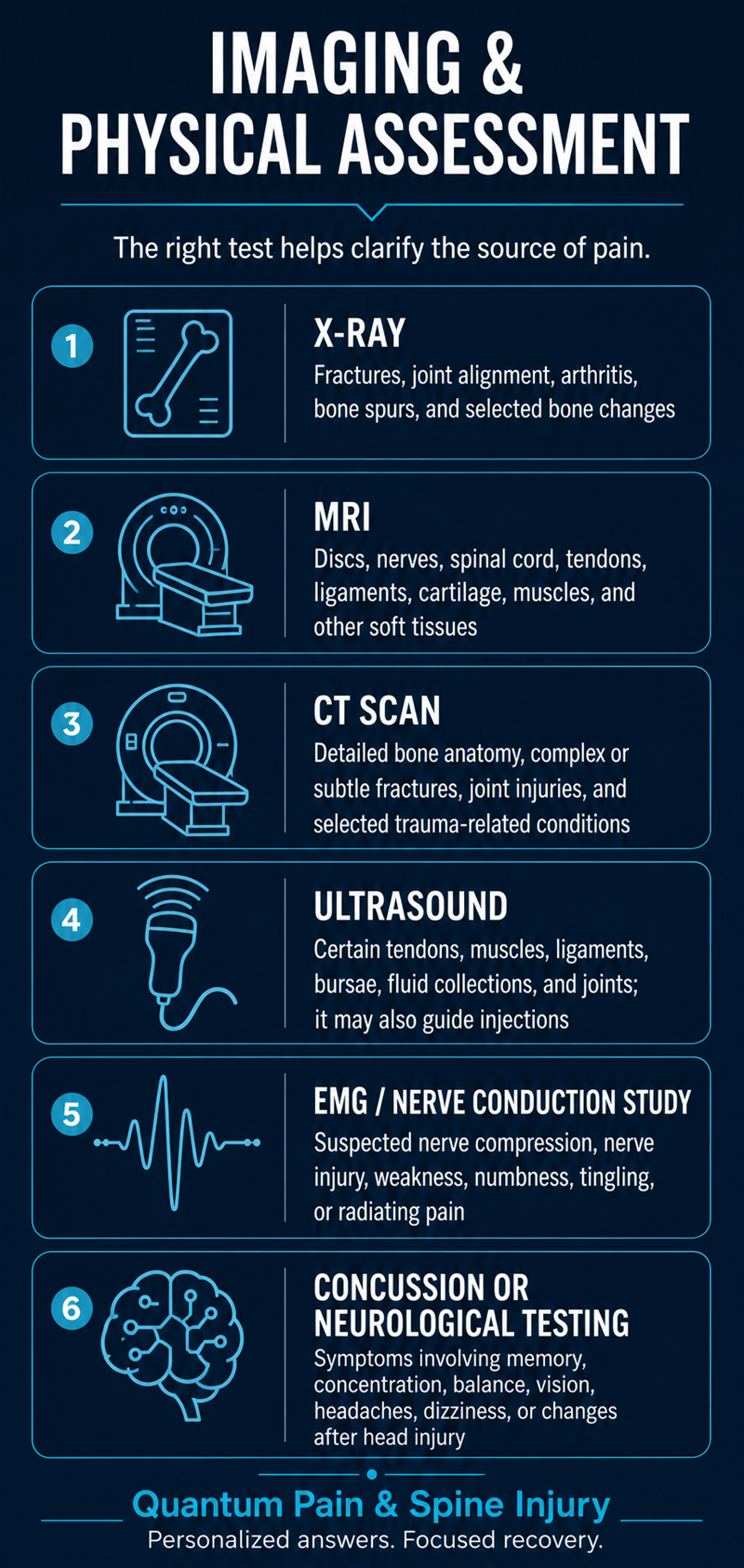
An MRI, X-ray, CT scan, or ultrasound can provide important information, but imaging results must be considered alongside your symptoms, medical history, and physical examination. Some imaging findings are common even in people without pain, while some injuries may be best identified through specific movement, strength, stability, or neurological tests.
Mayo Clinic notes that imaging studies are most useful when used with a careful history and physical examination to determine the cause of pain. mayoclinic.org
Our goal is to connect the clinical picture: what happened, where symptoms occur, how your body responds to movement, and whether imaging supports a specific diagnosis.
What Happens During a Physical Assessment
A targeted physical assessment helps identify painful structures, functional limits, and signs of injury that may not be visible on a scan alone.
Depending on your symptoms, your provider may evaluate:
- Posture, gait, balance, and coordination.
- Joint movement and range of motion.
- Muscle strength, endurance, and symmetry.
- Tenderness, swelling, bruising, spasm, or deformity.
- Joint stability and ligament integrity.
- Functional movement, including bending, lifting, reaching, walking, squatting, gripping, or climbing stairs.
- Numbness, tingling, reflexes, sensation, and weakness that may indicate nerve involvement.
- Headache, dizziness, concentration, vision, balance, or other concussion-related symptoms when appropriate.
For neck and spine conditions, an examination may include checking tenderness, muscle weakness, numbness, range of motion, reflexes, and gait. pmc.ncbi.nlm.nih
When Imaging May be Recommended
Imaging is not necessary for every pain condition. Many muscle strains, minor sprains, overuse injuries, and uncomplicated back or neck pain can be evaluated clinically and treated conservatively at first.
However, additional testing may be appropriate when you have:
- A significant accident, fall, direct impact, or suspected fracture.
- Severe pain that does not improve as expected.
- A joint that feels unstable, locks, gives out, or cannot bear weight.
- Persistent swelling, weakness, loss of motion, or deformity.
- Numbness, tingling, radiating pain, or loss of strength.
- Severe or worsening neck or back pain.
- Headache, dizziness, memory concerns, vision changes, or balance problems after a head injury.
- Symptoms that continue despite an appropriate course of conservative treatment.
- Signs of infection, inflammation, tumor, or another serious condition.
For certain trauma situations, plain radiographs are commonly an appropriate initial imaging study. The ACR’s acute hand and wrist trauma criteria, for example, rates radiography of the area of concern as “usually appropriate” for initial imaging. acsearch.acr.org
Making Sense of Your Results
A report can use unfamiliar terms such as “degenerative changes,” “disc bulge,” “tendinosis,” “effusion,” “stenosis,” or “labral tear.” These findings do not always explain your symptoms or determine whether you need a procedure or surgery.
Your provider will review your results in context and explain:
- What the study shows—and what it does not show.
- Whether a finding appears related to your current symptoms.
- Whether the result changes your diagnosis or treatment plan.
- Whether conservative treatment, physical therapy, medication, injection therapy, regenerative medicine, or surgical consultation is appropriate.
- Whether additional testing or specialist evaluation is needed.
We believe you should leave with clear answers, not just a report full of medical terminology.
Red Flags Requiring Urgent Care
Call 911 or seek emergency care immediately if you have:
- New loss of bowel or bladder control.
- Numbness in the groin or inner-thigh area.
- Sudden or worsening weakness in an arm or leg.
- Severe headache, repeated vomiting, seizure, confusion, fainting, or inability to wake up after a head injury.
- A visible deformity, open wound, or inability to bear weight after a major injury.
- Fever with severe back or neck pain, or a hot, red, swollen joint.
- Chest pain, shortness of breath, or symptoms that may indicate a heart or lung emergency.
Frequently Asked Questions
Will I need an MRI?
Not necessarily. MRI is valuable for evaluating many soft-tissue, spine, disc, nerve, tendon, ligament, and cartilage concerns, but it is ordered when it is likely to clarify the diagnosis or guide a change in treatment.
Can I have a serious injury if my X-ray is normal?
Yes. X-rays are especially useful for bones and alignment, but they may not show injuries to discs, nerves, tendons, ligaments, cartilage, or muscles. Your symptoms and examination help determine whether further assessment is needed.
Why do you examine areas that do not hurt?
The body works as a connected system. Evaluating related joints, muscles, and nerves can help identify referred pain, altered movement patterns, compensation, or a source of symptoms outside the area where you feel pain.
Will imaging determine whether I need surgery?
Imaging is one part of the decision. Surgical recommendations also depend on your symptoms, physical findings, functional limits, neurologic status, treatment history, and overall health.
Can you review imaging that was ordered elsewhere?
Yes. Bring your imaging report and, when available, the actual images or electronic access information. Reviewing existing studies may help avoid unnecessary repeat testing.
Get Help Today!
If pain, weakness, numbness, instability, headaches, dizziness, or limited mobility are keeping you from normal life after an injury, a focused physical assessment and appropriate imaging can help clarify what is happening. Quantum Pain & Spine Injury can evaluate your symptoms, review prior studies, and develop a treatment plan built around your diagnosis and recovery goals.
References
- American College of Radiology. ACR Appropriateness Criteria®. Evidence-based guidance to support appropriate imaging and treatment decisions across a range of clinical conditions. Available at: https://www.acr.org/Clinical-Resources/Clinical-Tools-and-Reference/Appropriateness-Criteria[acr]
- Mayo Clinic. Neck Pain: Diagnosis and Treatment. Discusses how medical history, physical examination, X-ray, CT, MRI, and electromyography may be used to identify causes of neck pain and nerve-related symptoms. Available at: https://www.mayoclinic.org/diseases-conditions/neck-pain/diagnosis-treatment/drc-20375587[mayoclinic]
- American College of Radiology. ACR Appropriateness Criteria®: Acute Hand and Wrist Trauma. Provides guidance on the use of radiography and additional imaging for acute traumatic hand and wrist injuries. Available at: https://acsearch.acr.org/docs/69418/narrative/[acsearch.acr]
- National Institute of Neurological Disorders and Stroke. Traumatic Brain Injury (TBI). Reviews neurological assessment after head injury, including evaluation of motor and sensory function, coordination, balance, mental status, speech, hearing, and behavior. Available at: https://www.ninds.nih.gov/health-information/disorders/traumatic-brain-injury-tbi[ninds.nih]