
Neck and Back Pain After a Car Accident

Don’t Ignore These Warning Signs
Experiencing neck or back pain after a car accident is extremely common—but it’s never “normal.” Even low‑speed collisions can injure the spine, muscles, ligaments, discs, and nerves. At Quantum Pain & Spine Injury, our multidisciplinary team specializes in early evaluation and treatment of neck and back injuries so they don’t turn into long‑term, life‑altering pain.
Whether your pain started immediately or showed up days later, it’s a sign that your body has absorbed more force than it can handle. Prompt, expert care can mean the difference between a full recovery and years of chronic pain.
Why Neck and Back Pain After a Car Accident Is Serious
Car accidents expose your spine to sudden, powerful forces in multiple directions—forward, backward, side‑to‑side, and rotational. Even if your vehicle looks minimally damaged, your neck and back may have been:
- Whipped back and forth (whiplash)
- Compressed or twisted beyond normal limits
- Forced into unnatural positions by seatbelts, airbags, or impact
- Jerked violently as your body moved differently from your head
Key reasons not to ignore post‑accident neck and back pain:
- Pain may signal disc herniations, ligament tears, vertebral fractures, or nerve compression.
- Symptoms can be delayed; what feels like “tightness” today can become severe pain and nerve symptoms tomorrow.
- Untreated acute injuries often lead to chronic pain, reduced mobility, and degenerative changes in the spine.
- Early evaluation provides documentation that your pain is directly related to the collision, which is important for insurance and long‑term care planning.
Common Neck Injuries After Car Accidents
Whiplash and Soft Tissue Strain
Rapid back‑and‑forth motion of the head and neck stretches and tears muscles, ligaments, and tendons in the cervical spine.
Typical symptoms:
- Neck pain and stiffness
- Pain that worsens with movement
- Headaches (especially at the base of the skull)
- Shoulder and upper back pain
- Limited ability to turn or bend your neck
Cervical Disc Injuries
Discs between the vertebrae can bulge or herniate when subjected to sudden compressive or twisting forces.
Possible signs:
- Deep, aching neck pain
- Pain radiating into the shoulder, arm, or hand
- Numbness or tingling in fingers
- Weakness in arm or grip strength
Facet Joint Injuries
Small joints along the back of the spine can be damaged, inflamed, or irritated during impact.
Common features:
- Localized neck pain on one or both sides
- Pain with looking up, turning, or bending
- Stiffness, especially in the morning or after inactivity
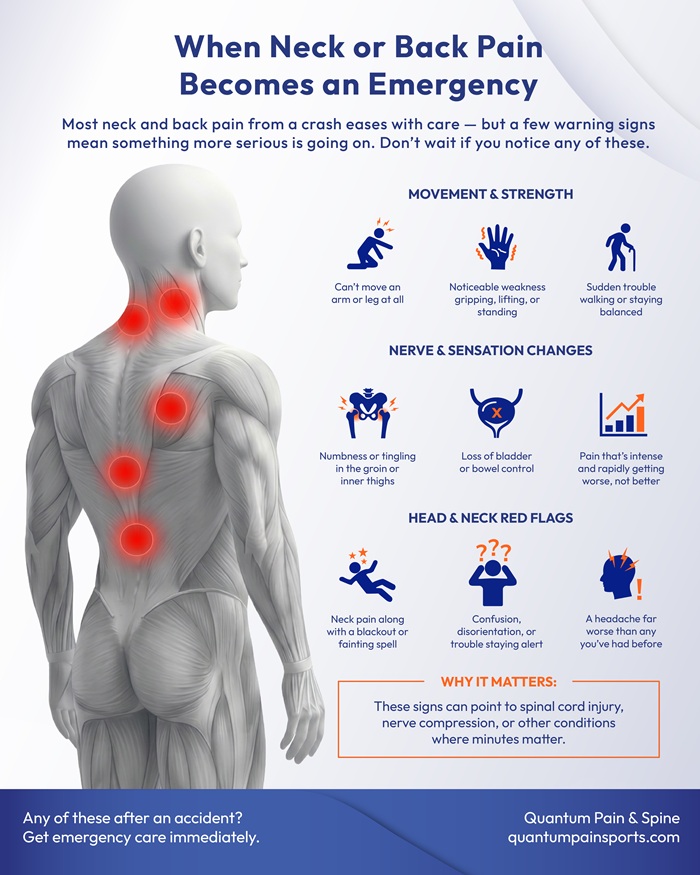
Red‑Flag Symptoms: When Neck or Back Pain Is an Emergency
Seek emergency care immediately if you experience neck or back pain after a car accident along with:
- Inability to move your arms or legs
- Significant weakness in hands, arms, legs, or feet
- Loss of bladder or bowel control
- Numbness or tingling in the groin (“saddle” area)
- Severe, unrelenting pain that rapidly worsens
- Difficulty walking, standing, or maintaining balance
- Severe neck pain with loss of consciousness, confusion, or severe headache
These may indicate spinal cord injury, severe nerve compression, or other life‑threatening conditions that require immediate intervention.
Why Pain Can Be Delayed After a Collision
It’s common to feel “okay” immediately after a crash, then wake up the next day barely able to move. That doesn’t mean the injury is minor—only that your body was in shock.
Reasons symptoms may appear hours or days later:
- Adrenaline masks pain immediately after impact.
- Inflammation builds gradually around injured tissues.
- Muscle guarding and spasms increase over time.
- Nerve irritation from disc bulges or swelling can develop slowly.
Because of this, any new neck or back pain in the days after a car accident should be evaluated, even if the crash seemed minor.
Our Comprehensive Neck and Back Evaluation After Car Accidents
At Quantum Pain & Spine Injury, we use a structured, thorough process to understand exactly what’s causing your pain and how serious it is.
1. Detailed History
We begin by discussing:
- How the accident happened (impact direction, speed, vehicle position)
- When symptoms started and how they’ve changed
- What makes the pain better or worse
- Any prior neck or back issues
- Other symptoms (headache, dizziness, numbness, weakness, sleep problems)
2. Physical and Neurological Examination
Our specialists assess:
- Range of motion in neck and back
- Muscle strength and flexibility
- Spinal alignment and posture
- Areas of tenderness or spasm
- Reflexes, sensation, and motor function
- Gait and balance
3. Advanced Imaging When Needed
Depending on your exam and symptoms, we may order:
- X‑rays to check for fractures, misalignment, or degenerative changes
- MRI to evaluate discs, nerves, ligaments, and soft tissues
- CT scans for complex fractures or detailed bone assessment
- Nerve conduction studies if nerve damage is suspected
This combination of history, examination, and imaging allows us to accurately diagnose everything from mild strains to significant disc or joint injuries.
Treatment Options for Neck and Back Pain After a Car Accident
Our goal is not just to reduce pain, but to restore function and prevent long‑term complications. Treatment is customized to your specific injuries and symptoms.
Conservative and Non‑Invasive Care
Medication Management
- Anti‑inflammatory medications (when appropriate)
- Short‑term muscle relaxants for spasm
- Targeted pain medications as needed and monitored
Physical Therapy & Rehabilitation
- Gentle stretching and range‑of‑motion exercises
- Strengthening for neck and core muscles
- Posture and body mechanics training
- Manual therapy for soft tissue and joint mobility
- Gradual return‑to‑activity programs
Bracing and Support
- Short‑term cervical collars in select cases
- Lumbar supports or braces when indicated
- Guidance on proper use to avoid weakening muscles
Interventional Pain Procedures
When conservative care isn’t enough, our pain management physicians offer minimally invasive procedures that directly target the source of your pain:
- Epidural steroid injections for disc‑related nerve pain (radiculopathy, sciatica)
- Facet joint injections to reduce inflammation in damaged spinal joints
- Medial branch blocks to diagnose facet‑related pain
- Radiofrequency ablation to provide longer‑term relief by disrupting pain‑carrying nerves
- Trigger point injections for persistent muscle spasms and knots
Advanced and Regenerative Therapies
- Shockwave therapy to promote healing in injured soft tissues
- Regenerative medicine (such as PRP or stem‑cell–based approaches) to support repair of ligaments, tendons, and discs
- Peripheral magnetic stimulation to reduce spasm and improve circulation
Surgical Evaluation and Care
If conservative and interventional treatments are not enough—or if you have structural problems that require surgery—our:
- Spine surgeons evaluate disc herniations, instability, and fractures
- Orthopedic surgeons address joint or structural injuries
- Neurosurgeons manage complex neurological and spinal cord issues
Whenever possible, minimally invasive techniques are used to shorten recovery time and reduce tissue disruption.
Integrating Neck and Back Care With Concussion and PTSD Treatment

Neck and back pain after a car accident rarely exists in isolation. Many patients also experience:
- Concussion symptoms (headache, dizziness, cognitive changes)
- PTSD or post‑accident stress (anxiety, sleep problems, fear of driving)
Our concussion specialists and psychiatrists work closely with your spine care team so that:
- Medications don’t conflict.
- Rehabilitation programs support both physical and neurological recovery.
- Emotional and psychological factors that can amplify pain are addressed compassionately and effectively.
This integrated approach helps you heal as a whole person, not just a set of isolated injuries.
Preventing Neck and Back Pain From Becoming Chronic
You can’t control the accident—but you can control how quickly and thoroughly you respond to your injuries.
Key steps to reduce the risk of chronic pain:
- Get evaluated within days—not weeks—of the collision.
- Follow through with recommended imaging and follow‑up visits.
- Start physical therapy early, even if pain is mild.
- Stay as active as your doctor recommends—prolonged rest often delays recovery.
- Communicate openly about new or changing symptoms.
- Address sleep, stress, and mood, which all influence pain perception.
The earlier we identify and treat mechanical, neurological, and psychological contributors to your pain, the better your long‑term outlook.
Frequently Asked Questions
Can neck and back pain start days after the accident?
Yes. Many people feel only “sore” or “tight” at first, then develop significant pain 24–72 hours later as inflammation builds and muscles tighten. Delayed onset does not mean the injury is minor—it’s a common pattern in whiplash and soft‑tissue injuries.
Is it safe to wait and see if the pain goes away on its own?
We don’t recommend a “wait and see” approach after a car accident. Some mild soreness may improve, but more serious injuries can worsen silently. Early evaluation lets us rule out serious problems and treat injuries before they become chronic.
Do I need an MRI if my X‑ray was normal?
Possibly. X‑rays show bones and alignment but not soft tissues like discs, ligaments, nerves, and muscles. If you have ongoing pain, nerve symptoms, or specific exam findings, an MRI can reveal injuries missed on X‑ray.
What if my neck and back pain are mild?
Mild pain can still signal underlying injury—especially if it’s new since the accident. Even if the pain is tolerable, a baseline evaluation helps catch issues early and provides documentation if symptoms worsen later.
Can a low‑speed crash really cause serious neck or back injury?
Yes. Significant whiplash and soft‑tissue injuries can occur at speeds as low as 5–10 mph, especially in rear‑end collisions. Vehicle damage does not always reflect the forces transmitted to your body.
Will I need surgery if I have a disc injury?
Not necessarily. Many disc injuries improve with conservative treatment and interventional procedures. Surgery is reserved for cases with severe nerve compression, instability, or when non‑surgical care fails. Our goal is always the least invasive effective option.
How long does it take to recover from neck or back injuries after a car accident?
It varies. Mild strains may heal in a few weeks; more complex injuries can take months. Factors like prior spine problems, overall health, and adherence to treatment all influence recovery time. We’ll give you a realistic timeline based on your specific diagnosis.
Can I keep working or exercising with neck and back pain?
In many cases, yes—with modifications. We’ll advise you on what’s safe and what to avoid. Light activity often speeds recovery, but certain movements, loads, or sports may need to be restricted temporarily.
What if I also have headaches, dizziness, or trouble concentrating?
These can be signs of a concussion or cervical‑related headaches. We’ll evaluate your brain and neck together, and may involve our concussion specialists to create a combined treatment plan.
Is it too late to get help if my accident was weeks or months ago?
It’s never too late to seek care—but the sooner you do, the better. Even if your accident was some time ago, we can still diagnose the cause of your neck and back pain and build a plan to improve your function and quality of life.
Don't Let Whiplash Become Chronic Pain
Neck and back pain after a car accident is your body’s way of saying something needs attention. You don’t have to live with the uncertainty—or the pain.