
Tendon and Overuse Gym Injuries
When Repetition Outpaces Recovery
Not every gym injury happens in one bad rep. Tendon and overuse injuries usually build slowly, as repeated stress outpaces the body’s ability to recover. They’re common in lifters, runners, and anyone doing the same movements over and over without enough rest, technique correction, or load management. pmc.ncbi.nlm.nih
At Quantum Pain & Spine Injury, we help identify the tissue that’s irritated, why it became overloaded, and how to get you back to training without turning a manageable problem into a long-term one.
Why Tendon and Overuse Injuries Matter
Tendons are especially vulnerable to repeated load because they transmit force from muscle to bone. Overuse injuries are a major share of sports injuries overall, and they’re a frequent cause of pain in people who train hard or repeat the same movement pattern day after day. pmc.ncbi.nlm.nih
Three helpful statistics:
- A systematic review found overuse injuries had a pooled prevalence of 42% in individual sports and 33% in team sports. pubmed.ncbi.nlm.nih.gov
- In resistance training injuries, sprains and strains account for 46.1% of all reported injuries, and chronic injuries are often tied to overuse.
- In one review of weightlifting and powerlifting injuries, chronic injuries made up about 30% of reported injuries, with tendon overuse a meaningful part of that group.
That’s why “minor” tendon pain should not be ignored if it keeps coming back with training.
Common Tendon and Overuse Patterns
Tendon pain
Common tendon problems in the gym include:
- Achilles tendinopathy.
- Patellar tendinopathy.
- Rotator cuff tendinopathy.
- Elbow tendon pain.
- Wrist and forearm tendon irritation.
These often start as stiffness or pain during exercise, then progress to pain that lingers after training or appears sooner in the workout than it used to.
Repetitive strain
Some overuse injuries are not isolated to one tendon. They involve the broader load system:
- Repeated pressing, pulling, squatting, or jumping.
- Poor recovery between sessions
- Technique that shifts too much stress onto one structure.
- Training through soreness until the tissue stops tolerating load.
Bursitis and irritation around the tendon
In some cases, nearby bursa, joint tissue, or muscle attachments also become irritated, which makes the pain feel broader and more persistent.
Signs You Should Pay Attention To
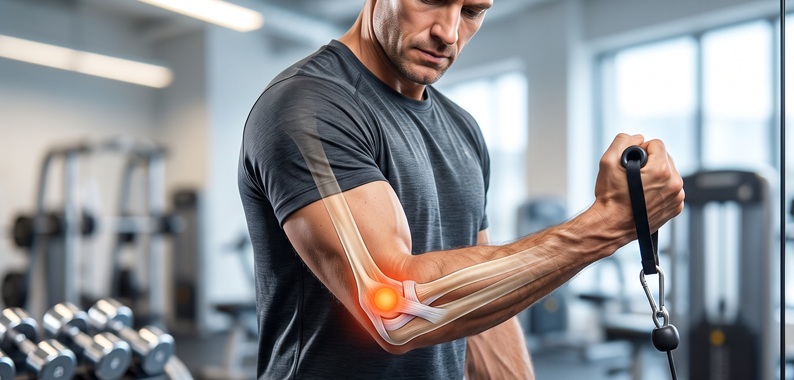
Overuse injuries are often subtle at first. Watch for:
- Pain that warms up during exercise but returns later.
- Morning stiffness that improves after moving.
- Tenderness in one specific tendon or attachment point.
- Loss of power, endurance, or confidence in the movement.
- Pain that appears earlier in the workout over time.
- Symptoms that improve with rest but come back as soon as training resumes.
If the pattern keeps repeating, the issue is usually not just “tightness.”
How We Evaluate Tendon and Overuse Injuries
Your evaluation focuses on both the painful area and the training pattern behind it. We look at:
- The exact exercise or movement that triggers symptoms.
- Recent increases in volume, load, frequency, or intensity.
- Your movement mechanics, strength, and flexibility.
- Whether pain is localized to one tendon or part of a broader overload pattern.
- Whether imaging is needed to rule out a tear, stress injury, or other structural issue.
The goal is to figure out why the tendon is failing to keep up with demand.

Treatment Options
Treatment depends on the structure involved and how long the injury has been building. Your plan may include:
- Temporary reduction in training load.
- Exercise modification rather than total rest when safe.
- Physical therapy to improve load tolerance and movement control.
- Shockwave therapy for stubborn tendon pain.
Regenerative or biologic treatments in selected cases. - Supportive taping or bracing when appropriate.
- A gradual return-to-training plan that rebuilds capacity step by step.
The real target is not just pain relief. It’s restoring the tendon’s ability to tolerate the work you want it to do.
Why Early Treatment Helps
Tendon injuries often become more stubborn if you keep loading them the same way. Early care can:
- Shorten recovery time.
- Reduce the chance of progressing to a partial tear.
- Help you stay active with safer modifications.
- Prevent one irritated tendon from turning into a whole-chain movement problem.
The sooner you address the load mismatch, the easier it is to fix.
Frequently Asked Questions
Is tendon pain the same as tendonitis?
Not always. “Tendonitis” implies inflammation, but many chronic tendon problems are better described as tendinopathy or tendon overload. The treatment approach often overlaps, but the exact diagnosis matters.
Can I keep training with tendon pain?
Sometimes, yes, but only with the right modifications. Pain that changes your form or keeps getting worse is a sign you’re asking too much of the tissue.
Do tendon injuries heal with rest alone?
Sometimes they calm down with rest, but many need a more complete plan that includes progressive loading, movement changes, and rehab.
How long does recovery take?
It varies. Some tendon problems improve in weeks, while more chronic overuse injuries can take longer.
Will I need imaging?
Not always. We consider imaging if symptoms are severe, persistent, or not matching a typical overuse pattern.
Don’t Lift Through Back Pain
If your tendon pain keeps coming back, gets worse as you train, or is starting to limit what you can do in the gym, it’s time to get it checked. Quantum Pain & Spine Injury can help you identify the source, calm the irritation, and build a plan to return to training safely.
References
- Franco MF, et al. Prevalence of overuse injuries in athletes from individual and team sports: a systematic review with meta-analysis. 2021. Pooled period-prevalence of overuse injuries was 42% in individual sports and 33% in team sports.
- Golshani K, et al. Upper extremity weightlifting injuries: Diagnosis and management. 2017. The U.S. Consumer Product Safety Commission data included 25,335 weight training injuries; sprains and strains accounted for 46.1% of resistance training injuries.
- Aasa U, et al. Injuries among weightlifters and powerlifters: a systematic review. 2017. Chronic injuries made up about 30% of reported injuries, and tendon overuse was a notable contributor.