
Pain Management
Personalized Care for Pain That Disrupts Your Life
Pain can change the way you work, sleep, drive, exercise, and spend time with the people you love. It can also make recovery after an accident, work injury, sports injury, surgery, or repetitive-use condition feel uncertain and frustrating.
Quantum Pain & Spine Injury provides comprehensive pain management focused on identifying the source of your symptoms and helping you regain meaningful function. We use a thoughtful combination of non-surgical treatments, medication evaluation, image-guided procedures, rehabilitation coordination, and specialty referrals when appropriate.

Pain Care Begins With Listening
Pain is personal, and two people with the same diagnosis may need different treatment plans. During your evaluation, we look beyond a pain score to understand how symptoms started, where they occur, what makes them worse or better, and how they affect your daily life.
Your care may include a review of:
- The injury, accident, or activity that started your symptoms.
- Pain location, intensity, pattern, and duration.
- Numbness, tingling, weakness, headaches, dizziness, sleep disruption, or muscle spasm.
- Prior imaging, medical records, therapy, surgeries, medications, and procedures.
- Work duties, sport demands, driving, household tasks, and other functional limitations.
- Anxiety, depression, stress, trauma symptoms, and other factors that can affect pain and recovery.
The result is a treatment plan based on your diagnosis, symptoms, function, medical history, and personal goals—not a one-size-fits-all approach.
Explore Our Specialties
Pain management may help patients with acute, subacute, and chronic symptoms involving the spine, joints, nerves, muscles, and soft tissues. Common concerns include:
- Neck pain, whiplash, and cervical radiculopathy.
- Low-back pain, sciatica, and lumbar radiculopathy.
- Disc-related pain, spinal stenosis, facet-joint pain, and sacroiliac joint pain.
- Headaches and selected pain conditions after injury.
- Shoulder, elbow, wrist, hand, hip, knee, ankle, and foot pain.
- Joint pain, arthritis, tendon conditions, muscle strain, and myofascial pain.
- Numbness, tingling, burning, weakness, and other nerve-related symptoms.
- Persistent pain after an accident, work injury, sports injury, surgery, or fracture.
- Complex pain that has not improved with initial conservative treatment.
Your Treatment Options
Effective pain care often combines multiple approaches. The CDC recommends maximizing appropriate nonpharmacologic and nonopioid treatments for pain, and notes that nonopioid therapies are preferred for subacute and chronic pain. cdc
Medication management
Medication may be one part of treatment, but it is rarely the entire plan. Depending on your diagnosis and medical history, options may include topical therapies, anti-inflammatory medicines, non-opioid pain medicines, medications for nerve-related symptoms, muscle-relaxing medicines, or medications that support sleep and function.
We carefully consider expected benefits, potential side effects, interactions, and your individual risk factors. Opioids are not automatically prescribed and are considered only when their expected benefits for pain and function outweigh their risks.
Image-guided procedures
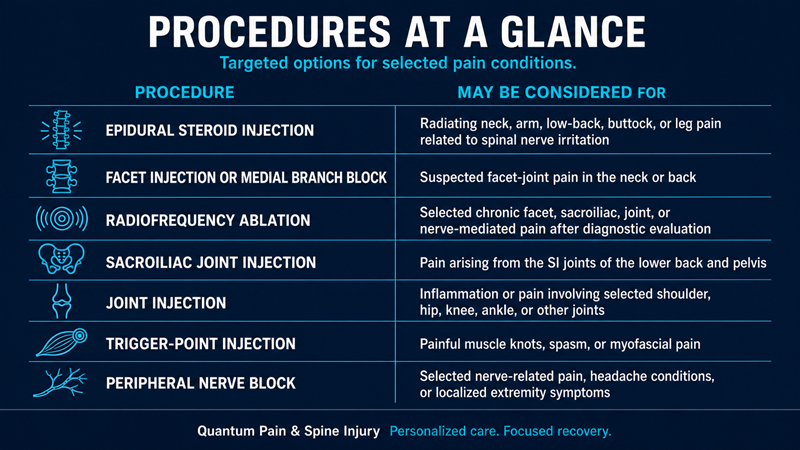
Targeted procedures may be considered when a specific pain generator is identified or when pain prevents meaningful participation in rehabilitation. Depending on the diagnosis, these may include:
- Epidural steroid injections.
- Facet-joint injections and medial branch blocks.
- Radiofrequency ablation.
- Sacroiliac joint injections.
- Peripheral nerve blocks.
- Joint injections.
- Trigger-point injections.
- Sympathetic nerve blocks.
- Selected regenerative or biologic procedures.
Interventional pain medicine can include epidural injections, nerve blocks, joint injections, radiofrequency treatments, and other targeted techniques used alongside rehabilitation, medication management, and behavioral-health care. pmc.ncbi.nlm.nih
Rehabilitation coordination
Movement is often part of recovery, but the right kind and pace matter. Although we do not provide physical therapy directly, we coordinate referrals to a trusted network of therapy providers who can help improve mobility, strength, balance, endurance, and safe return to activity.
If pain is making therapy difficult, we can reassess the plan and consider appropriate treatment options to help you participate more effectively.
Behavioral health and pain
Pain affects more than the body. Ongoing pain can disrupt sleep, increase stress, limit independence, and contribute to anxiety, depression, fear of movement, or PTSD symptoms after an injury.
Behavioral-health care can be an important part of pain management. It may include psychiatric evaluation, medication management, therapy coordination, coping strategies, sleep support, and treatment for trauma-related symptoms. Addressing both the physical and emotional effects of pain can support a more complete recovery.
Surgical and specialty referrals
Many painful conditions improve without surgery. When imaging, examination findings, or your response to treatment suggests that a specialist opinion is needed, we coordinate referrals to orthopedics, spine surgery, hand surgery, neurosurgery, or other appropriate specialists.
A referral does not automatically mean surgery. It is a way to clarify your options and make sure your care is directed to the right expertise.
What to Expect
Your care plan begins with a detailed assessment and clear discussion of your options. Depending on your needs, the process may include:
- Evaluation: Review your injury, symptoms, physical findings, prior records, and imaging.
- Diagnosis: Identify the likely pain generator and determine whether further imaging or testing is needed.
- Plan: Discuss conservative care, medications, rehabilitation referral, procedures, behavioral-health support, or specialist referral.
- Treatment: Begin the options that best match your condition and goals.
- Reassessment: Track changes in pain, movement, sleep, work tolerance, and daily function; adjust the plan when needed.
The goal is not simply to make a number on a pain scale smaller. It is to help you do more of what matters safely and sustainably.
Add Your Heading Text Here
Call 911 or go to the nearest emergency department for:
- New loss of bowel or bladder control.
- Numbness in the groin, inner thighs, buttocks, or genital area.
- Sudden or worsening weakness in an arm or leg.
- Severe headache, seizure, repeated vomiting, confusion, fainting, or inability to wake up after a head injury.
- Chest pain, shortness of breath, or symptoms of a possible heart or lung emergency.
- A visibly deformed joint, open injury, or suspected fracture after major trauma.
Frequently Asked Questions
Will pain management cure my injury?
Pain management may reduce symptoms, improve movement, and support rehabilitation, but the right outcome depends on the cause and severity of the condition. Some injuries heal over time; others require ongoing management, specialist care, or surgery.
Do I need to be in severe pain to see a pain-management provider?
No. Early evaluation may help clarify the source of symptoms and prevent pain from becoming more disruptive to work, sleep, movement, and daily life.
Are injections a substitute for physical therapy?
Usually not. Procedures may help reduce pain or inflammation so that you can participate more effectively in therapy, but rehabilitation remains an important part of recovery for many injuries.
Will I receive opioid medication?
Treatment decisions are individualized. Current clinical guidance prioritizes nonpharmacologic and nonopioid options for many pain conditions, particularly subacute and chronic pain.[ cdc
How quickly will I feel better?
Recovery varies. Some treatments provide relief quickly, while others require time, consistent rehabilitation, and reassessment. Your provider will discuss realistic goals and timelines based on your diagnosis.
Get Help Today!
You do not have to accept pain as the price of returning to life after an injury. Quantum Pain & Spine Injury can help identify the source of your symptoms, explain your treatment options, and create a plan focused on reducing pain, restoring function, and helping you move forward.
References
- Centers for Disease Control and Prevention. Nonopioid Therapies for Pain Management.[cdc]
- Centers for Disease Control and Prevention. CDC Clinical Practice Guideline for Prescribing Opioids for Pain — United States, 2022.[pmc.ncbi.nlm.nih]
- Mayo Clinic. Pain Medicine: Overview.[mayoclinic]
- Interventional Pain Management in Multidisciplinary Chronic Pain. Journal of Pain Research.[pmc.ncbi.nlm.nih]
- UCLA Health. Pain Management Procedures.[uclahealth]